


The UK's Social Media Ban for Under-16s: What Parents Need to Know
Today could prove to be one of the most significant moments in the UK's approach to children's online safety.
For years, parents, schools, campaigners and politicians have debated whether children should have access to social media. Today, the government announced plans that will prevent under-16s from accessing some of the world's biggest social media platforms.
Unsurprisingly, the announcement has generated huge discussion.
Some people see it as a long-overdue step towards protecting children online. Others worry it won't work, won't be enforceable, or represents government overreach into family life.
As someone who spends much of my time working with parents, schools and young people on online safety, my phone has barely stopped buzzing since the news broke.
What has been announced?
The government has announced plans to introduce a legal social media age limit of 16. If the proposals become law, children under the age of 16 would no longer be able to access a range of major social media platforms.
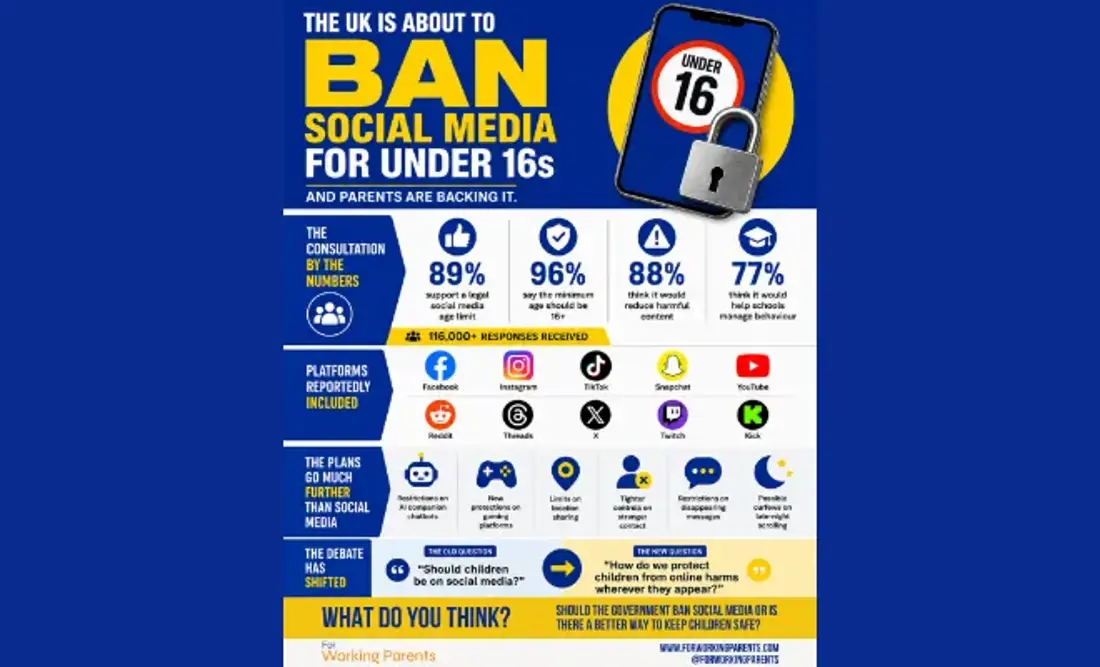
The proposal follows a public consultation that received more than 116,000 responses.
According to the government's figures:
- 89% supported a legal social media age limit
- 96% believed the minimum age should be 16 or older
- 88% felt it would reduce children's exposure to harmful content
- 77% believed it would help schools manage behaviour and wellbeing
Those are extraordinary numbers and demonstrate just how concerned many families have become about children's experiences online.
However, one thing that's important to understand is that today's announcement isn't simply about social media.
In many ways, it's about redefining how we protect children across the wider digital world.
Which platforms will be affected?
The proposals cover most of the platforms that parents typically think of when discussing social media.
These include:
- TikTok
- Snapchat
- X
- Threads
- Twitch
- YouTube
- Kick
The government's position is that these platforms expose children to a combination of algorithmically recommended content, social pressures, harmful material and contact risks that require stronger safeguards.
Messaging services such as WhatsApp and Signal are not currently included within the proposed ban, although further reviews may take place in the future.
How would the ban actually work?
This is probably the question I've been asked most today.
The simple answer is that responsibility would sit with the platforms rather than with parents.
Social media companies would be required to verify users' ages and prevent under-16s from accessing their services.
While many parents are familiar with the current system of simply entering a date of birth, the government is proposing stronger age-assurance measures.
These could include technology such as facial age estimation, digital identity verification and other age-checking systems that are already being introduced under existing online safety legislation.
Ofcom is expected to oversee compliance and enforcement.
Exactly how each platform would implement these measures remains to be seen, and there will undoubtedly be further debate around privacy, accuracy and practicality.
What else was announced?
Much of the media coverage has understandably focused on the social media ban, but the wider package goes considerably further.
The government has announced plans to restrict access to AI companion chatbots for under-18s. These are systems designed to simulate emotional, romantic or highly personalised relationships with users.
There are also proposals to strengthen protections around:
- Stranger contact
- Livestreaming
- Location sharing
- Disappearing messages
- Online grooming risks
- Gaming platforms that allow communication with unknown adults
In addition, ministers are continuing to explore measures aimed at reducing excessive use among older teenagers, including potential restrictions on autoplay features, endless scrolling and late-night usage.
Not all of these proposals have been finalised, but they signal a significant shift in how policymakers are thinking about children's online lives.
When will it happen?
This is not an overnight change.
The proposals still need to pass through the legislative process and there are likely to be further consultations and discussions around implementation.
Current timelines suggest the government hopes to introduce the measures during 2027, although further details are expected in the coming months.
For parents wondering whether their child will lose access tomorrow, the answer is no.
There is still a considerable amount of work to be done before any ban comes into force.
My view
Anyone who follows my work will know that I support the proposal. Not because I think technology is bad or because I think social media is responsible for every challenge facing young people.
But, after years of speaking with parents, I know that many feel overwhelmed. They feel they are trying to parent against platforms designed to maximise engagement, capture attention and keep children online for as long as possible.
For many families, a legal age limit would provide clarity, consistency and support for decisions they are already trying to make.
That said, we should be careful not to see this as a silver bullet. The biggest mistake we could make is believing that online harm only exists on social media and that a ban will resolve all the issues.
Today's children navigate a digital ecosystem that includes gaming platforms, messaging apps, video-sharing sites, AI tools and countless other online spaces. Harmful content, algorithmic recommendations and stranger contact don't suddenly disappear because social media access is delayed.
That's why legislation must be accompanied by education and digital literacy. I want to see a real focus on digital safeguarding, especially from schools, which is why I am launching the UK’s first ever Designated Digital Safeguarding Lead (DDiSL) Training Programme in September.
The proposed ban is a hugely important step. But it should be viewed as the beginning of a wider conversation, not the end of one.
Because the real question isn't simply whether children should be on social media. It's how we create a digital world that genuinely deserves children in it.
Amit is the founder of For Working Parents, a company that helps organisations, schools and colleges build cultures where working parents and carers can thrive. A former Deputy Headteacher and ICF trained coach, Amit combines senior leadership experience with coaching expertise to create more empathetic, human-centred workplaces and educational environments. His work focuses on the rapidly evolving digital world young people inhabit, from social media algorithms and influencer culture to gaming, pornography, AI and coded online language, equipping parents, educators and leaders with the insight and confidence to recognise emerging risks, respond appropriately, and embed proactive digital safeguarding into their culture and practice. Amit’s LinkedIn profile and Instagram page provide regular digital advice and guidance for parents and his recent periodic table of emojis went globally viral, with schools, organisations, and media from around the world requesting copies of it to share with their communities. Amit is also a storyteller who speaks openly about his experiences as a turban-wearing Sikh man, including losing his mother to ovarian cancer, raising a daughter born with three holes in her heart, and being diagnosed with ADHD as an adult. These experiences bring compassion, authenticity, and vulnerability to his work.
Facebook/Instagram/TikTok: @forworkingparents
LinkedIn: @AmitSinghKalley
Website: forworkingparents.com
Email: [email protected]
 Originally Released On 15 June 2026