


 Released On 10 March 2025
Barbara's blog - The Art Of Happiness
I was talking to a friend about how our parenting style has had to evolve as the kids have grown up. Ensuring children were happy, which was the catch-all definition for being content, safe and well adjusted, was once enough, but these days, happiness is more nuancedly attuned to mental health and wellbeing. We agreed that, whilst it is generally straightforward to see if a young child is happy – through their facial expressions, tone of voice and general demeanour – it becomes more difficult with teenagers, for whom being sullen and insular is the general MO, and even exponentially harder when young adults leave the safety of the home to go to university, no longer under our watchful eye.
We are close to this stage with Daughter and Son. I consider myself lucky that both kids are relatively good at sharing, both in terms of telling me where they go and with whom, and talking about how they feel about friendships, relationships, their future and life. As parents, we have always tried to encourage honest conversations around the dinner table. Food is the social glue that brings us all together, creating a safe space away from phones and other distractions. This is my mum’s legacy gift and our way to preserve a connection as a family.
It was during one of these conversations that we talked about happiness and, specifically, whether your natural predisposition towards it can help or hinder creativity. The discussion focused specifically on art, a discipline where internalising the externalities and projecting them out again requires you to both be porous to the mood of the moment and dig deep in your well of emotions.
“I might be too happy to be a successful artist”, said Daughter. I nearly butted in to argue this preposterous assertion, but, in the spirit of applying the evolved parenting style, I took a deep breath and waited for the rest. “A lot of art is fuelled by angst, trauma and political or social commentary. You need to be broken and able to use those feelings as commentary of the human condition to be a successful artist”.
I found this statement extraordinary. Are art and happiness mutually exclusive?
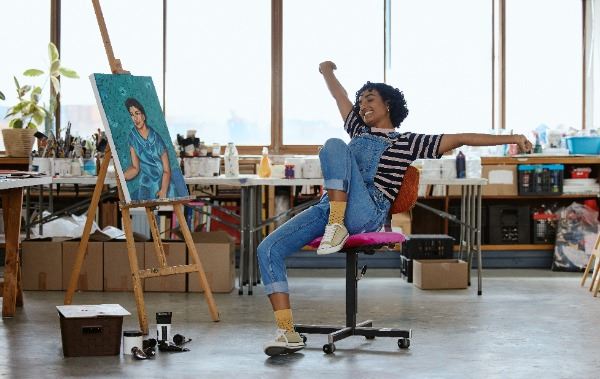
Daughter is gifted with a sunny and positive disposition, as well as a natural ability to find awe in the everyday, the latter being particularly important for an artist. She loves to paint on large canvases, with sweeping brush strokes that, as they flow, create texture and movement, seizing the beauty that surrounds her: the extraordinary essence in ordinary things. But Daughter feels penalised as an artist for lacking the emotional infrastructure that gives legitimacy to her work. Her art might speak to the observer through its formal features – the brushstrokes, the texture, the colour hues – but in her view it lacks enough of an inner message to give it worth. It is merely beauty at face value.
Is Daughter’s natural happiness hindering her ability to fulfil her dream career? I could sense the emotional struggle that was taking place. I wanted to tell Daughter that she was clearly talented, and that art was about feeling rather than seeing, but once again I chose to be still. Daughter knows she can paint – she already has two offers from universities to join the course she wants – so I would be stating the obvious.
Son, in his usual perceptive way, pointed out that the very inner turmoil that his sister was experiencing was perhaps enough to create the legitimacy she was looking for, and, if not, that he would gladly give her something to worry about!
I felt privileged to have had a glimpse into the emotions of a seemingly happy young adult and resisted wanting to offer advice or forcing a solution. This is certainly an example of the evolution that our parenting has had to undertake when supporting growing kids. Available, but relatively hands off.
Is it ultimately due to luck that the kids talk to us? Probably. And I have no illusion that they don’t share everything, but I take comfort in knowing that, for the most time, they are content and safe. Happy, even. And that is a parental win, hands down.
Barbara works as an environmental strategist for the aviation regulator and lives a stone’s throw from the South Downs, with her 19-year-old creative daughter, 17-year-old ingenious son and supportive husband.
No Comments